POWER QUALITY AND TRANSFORMER FIRE PROTECTION FOR CEMENT PLANT

Cement plants operate large motors, VFD-driven fans and mills, long cable feeders, and high-capacity transformers. These electrical systems can create harmonics, reactive power demand, voltage disturbances, and transformer fire risks. CTR provides engineered solutions for power quality improvement, voltage protection, reactive power compensation, and transformer fire and explosion protection across cement manufacturing facilities.

Power Factor Solution for Cement Plant

Electrical Profile of a Cement Plant

A cement plant combines large HT motor drives, VFD-fed fans and mills, long cable feeders and heavy-duty transformers. These loads influence the supply system in distinct ways:

Process area Typical electrical load Power quality effect
Crushing and raw material handling Large induction motors, direct-on-line or soft start High starting current, reactive power surges
Raw mill & cement mill HT motors, mill drives High and variable reactive power demand
Kiln ID fan, cooler fans, raw mill fans VFD-driven (6-pulse or 12-pulse) Harmonic current and power-quality distortion
Coal mill, packing plant, conveyors Mixed LT drives, cyclic loads Fluctuating PF and imbalance
Process control, DCS, PLC panels Sensitive electronics Susceptible to dips, surges and EMI
Plant substation Oil-filled power and furnace/rectifier transformers Fire and explosion risk on internal fault

CTR Solutions Applied in Cement Plants

Each electrical condition in a cement plant has a specific CTR product that addresses it.

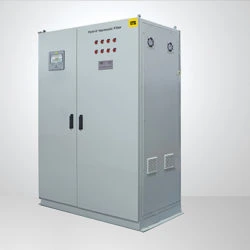
Hybrid Harmonic Reactor Filter

Where it applies: VFD-fed kiln ID fans, cooler fans, raw mill fans, and other rectifier-type loads on the LT bus.

Technical Description

Combines an active harmonic filter (AHF) with a passive filter stage, using common current transformers.

  • The passive stage carries the dominant low-order harmonics (typically 5th and 7th). The active stage injects compensating current for the residual spectrum and varying load conditions.
  • Suitable for non-linear loads above 200 kVA.
  • Voltage: 400 / 525 / 690 V AC.
  • Current rating: 50 A to 1200 A in a single cubicle.
  • Complies with IS 13340:1993.
Harmonic Filter Manufacturer

Reactive Power and Power Factor Management

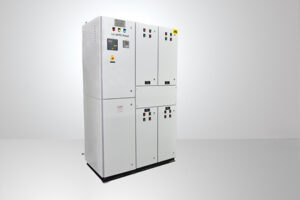
Realtime Power Factor Corrector

Realtime Power Factor Corrector
  • Rated voltage: 380 / 400 / 415 / 440 V.
  • Output: 10 kVAR to 1000 kVAR, 4 to 16 steps.
  • Contactor or thyristor switching, with detuning/anti-resonance reactors (0.2% to 14%).
  • Controller with monitoring, protection, data logging and RS-232/485 communication.

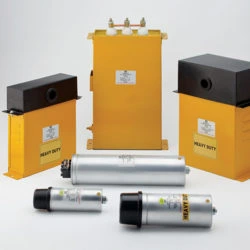
Power Factor Correction Capacitor

Power Factor Correction Capacitor
  • 415 V to 850 V, IS 13340::2024 standards.
  • Available in round / box type from 1KVAR to 25KVAR.
  • Withstand up to three times rated current and distorted voltage (harmonic-rich loads).
  • External fuse protection and discharge resistor.

Instantaneous PF Correction System (IPFC)

Where it applies: cyclic and imbalanced loads such as crushers, cranes and material handling equipment.

  • PLC-controlled with single CT sensing for load, handling imbalance and instantaneous variation.
  • Capacitor switching within 6 milliseconds of load on/off.
  • High-speed soft switching to limit switching transients.
  • Maintains power factor above 0.95 and a kWh to kVAh difference of about 1%.

MV/HV Reactive Power Compensator

Where it applies: HT motor drives, mill drives and plant-level compensation at 3.3, 6.6, 11 KV to 33 KV

  • Turnkey reactive compensation for large industrial installations.
  • Dynamic compensation where load variation exceeds the response of step-switched banks.
  • Harmonic filter reactors available in series/shunt configurations for MV and HV.

Voltage Disturbance Protection

Instantaneous Voltage Dip Compensator

Instantaneous Voltage Dip Compensator
  • Addresses grid-originated voltage sags that interrupt critical process loads.
  • Takes over load power during the disturbance, so process equipment such as kiln auxiliaries and control systems stays energised through the event.
  • Available with AC voltage 400V, 690V and in standard power ratings of 345KW,660KW, 1000KW and 1500 KW.
  • Saves >80% energy against online UPS systems.

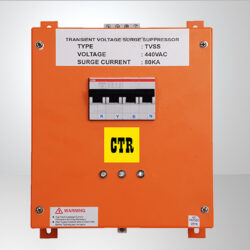
Transient Voltage Surge Suppressor

Transient Voltage Surge Suppressor

Where it applies: HT motor drives, mill drives and plant-level compensation at 3.3, 6.6, 11 KV to 33 KV

  • Turnkey reactive compensation for large industrial installations.
  • Dynamic compensation where load variation exceeds the response of step-switched banks.
  • Harmonic filter reactors available in series/shunt configurations for MV and HV.

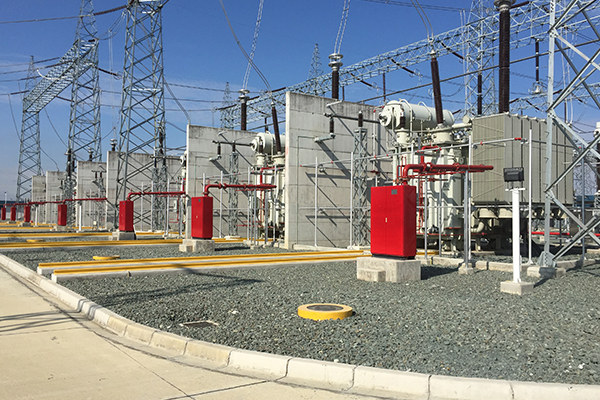
Transformer Fire and Explosion Protection: NIFPS

Nitrogen Injection Fire Protection System (Explosion Prevention and Fire Extinguishing System)

Plant transformers, including main power transformers, distribution transformers, furnace and rectifier transformers, and oil-filled reactors, hold large volumes of combustible mineral oil. An internal arcing fault produces rapid gas generation and tank pressure rise, which can lead to rupture and oil fire.

Principle of operation (Drain and Stir)

1. A fault signal is received from the transformer protection (differential relay, Buchholz relay, PRV/RPRR, breaker trip, and fire detector).

2. The Transformer Conservator Isolation Valve (TCIV) closes, preventing oil flow from the conservator into the tank.

3. The oil drain valve opens, releasing a pre-set volume of oil from the top of the tank to reduce pressure.

4. Nitrogen is injected at a pre-calculated flow and pressure from the bottom of the tank.
It agitates the oil, cools it below flash point, displaces oxygen and forms an inert layer
above the oil.

NIFPS System

Engineering Support for Cement Plant Electrical Systems

Selection should start from site data: harmonic spectrum at the PCC and drive terminals, the kVA/kW/kVAR profile across the production cycle, recorded sag events, existing capacitor bank configuration, and transformer oil volume and tank dimensions for NIFPS. CTR’s Energy Audit and Power Quality Analysis service provides this data and results in a technical report with a recommended equipment schedule.

To discuss your plant’s power quality or transformer protection requirement, contact CTR’s technical team with your single-line diagram, drive list and recent measurement data.

Cement Plant Enquiry