Why Utilities Trust CTR’s Automatic Power Factor Controller
Choosing an automatic power factor controller looks simple, but the wrong choice shows up later as hunting contactors, failed capacitors and unexpected penalties. This guide covers the questions utilities ask before choosing a controller and shows how CTR’s range answers them.
What Utilities Look for in an Automatic Power Factor Controller
Utilities rarely choose on price alone. They compare voltage compatibility, intelligence level, measurement accuracy, capacitor protection and switching technology, then check the approvals behind the product.
Start With Your Voltage Level
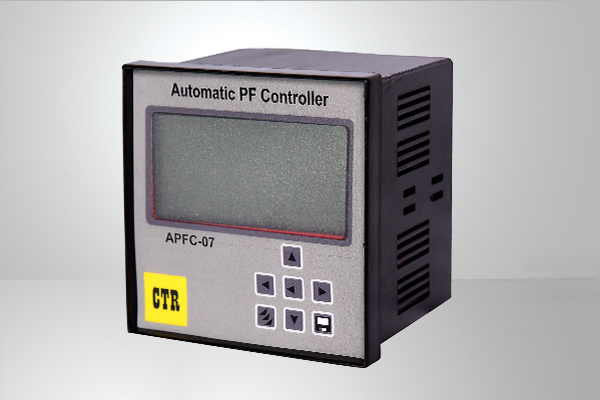
Low voltage panels are the most common case, and the low voltage controllers accept a wide supply range, from 90 V to 500 V AC or 550 V to 1000 V DC. This means that one model can serve panels with different auxiliary supplies, simplifying both stocking and spares.
Medium and high voltage networks need a different design. The high voltage controller senses all three phases on three or four wire systems and uses three additional current transformers to measure capacitor current directly. It has a separate measurement voltage input and a wide AC/DC auxiliary supply, and it can control up to eight capacitor banks.
Match the Controller to the Complexity of the Load
A steady industrial feeder may be well served by an economical controller, while a network with fast-changing loads benefits from an advanced one.The economical and smart models come in compact 96 mm and programmable 144 mm sizes, with four, six or eight relay outputs and a large LCD. The intelligent and advanced models add fully automatic setup, so commissioning does not depend on trial and error, and an expert programming mode for finer control over correction. All of these support 5 A and 1 A CT connections, so they fit existing CT arrangements.
Why Measurement Accuracy Matters
A controller can only correct what it measures. If readings drift, it switches too early, too late or not at all. The intelligent and advanced models are specified at class 1 accuracy for voltage and current and class 2 for active and reactive power, which keeps power factor close to target without overshooting into a leading condition.
Early Fault Detection That Protects Your Capacitors
Capacitors often fail first in a correction system, so they need dedicated protection. These controllers include several safeguards for the capacitor bank.The soft switch range adds deeper monitoring. It measures capacitor current and detects earth faults on the capacitor and detuned reactor. It tracks harmonic distortion (THD) and flags gradual loss of capacitance (kVAR deterioration). Thyristor and supply health are checked as well.Standard safeguards cover over and under voltage, over temperature, current spikes and voltage transients. Spotting faults early means fewer outages and lower replacement costs.
Choose the Right Switching Technology
Conventional contactors cause inrush currents and wear over time. Three options address this.Intelligent capacitor soft switches use thyristors to switch capacitors without the surge, in models for up to 500 V and 800 V phase to phase and current ratings from 25 A to 160 A. Hybrid switches combine thyristor and contactor technology for zero-surge switching with very low conduction losses, and they can nearly double capacitor life. They can replace a conventional AC-6B capacitor duty contactor and mount on a DIN rail or with standard bolts. For fast-changing loads, the advanced controller has a high-speed transistor output designed to drive the thyristor switches.
Easy Maintenance, Faster Troubleshooting
Small details matter during installation and maintenance.The hybrid switch uses fire-retardant material. It offers remote and local control for manual testing. Also it shows fault indications through LEDs. The soft switch supports remote and local override and displays capacitor current on a four-digit LED display, so technicians can diagnose problems quickly.
Certified Protection and Industry Compliance
The range is listed with IP55 and IP67 protection ratings, compliance with IS 13340:1993. Also, it is approved by industrial customers, which gives buyers evidence beyond a datasheet.
Which Controller Fits Your Network?
For stable low voltage loads, an economical or smart controller is usually sufficient. For variable loads, an intelligent controller paired with a soft or hybrid switch gives better protection and longer capacitor life. For medium and high voltage networks, the high voltage controller is the right starting point.
You can compare all variants and their specifications on the CTR power factor control relays page, or contact the CTR team to discuss the right configuration for your network.
REACH US
THANK YOU!
We've received your message and
we'll get back to you soon!