OnLoad Tap Changer (OLTC) Maintenance: Complete Guide for Industrial Transformers
In a power transformer, the on-load tap changer (OLTC) is the one major component. It operates under continuous electrical and mechanical stress. Also it is part most often behind transformer outages. A tap changer failure can take the entire transformer out of operation. In the worst case it can lead to fire.
This guide covers OLTC maintenance in practical terms, why it matters, what to inspect and which tests to perform. Then how to manage oil & spares. Also when to call a specialist.
What Is an On-Load Tap Changer and Why Is Regular Maintenance Important?
An On-Load Tap Changer (OLTC) is a device that allows a transformer to change its voltage while on load and supplying power.This provides a stable voltage to plants and utilities even with variations in the electrical load or the incoming supply voltage.During every tap change, the OLTC switches electrical current and its internal parts undergo mechanical movement. This can lead to contact wear, carbon deposits, and damage to transition resistors over time.The quality of the insulating oil is lowered due to arcing, moisture and contamination.
Regular OLTC maintenance detects this problem early and prevents it from developing into a failure.It also extends the product’s remaining life and protects the transformer it serves.
OLTC Types and Their Maintenance Needs
Maintenance depends heavily on the tap changer design:
Oil-type OLTC: Arcing takes place in the diverter switch oil, so oil condition and contact wear need the closest attention.
Vacuum-type OLTC: Switching happens inside vacuum interrupters. Oil stays much cleaner, so the maintenance load is lighter.
In-tank and flange-mounted OLTC: The mounting style changes how the tap changer is accessed, drained and inspected.
Dry-type OLTC: Used with dry-type transformers, where inspection focuses on contacts and mechanism rather than oil.
For details on the available designs, see CTR’s range of onload tapchangers.
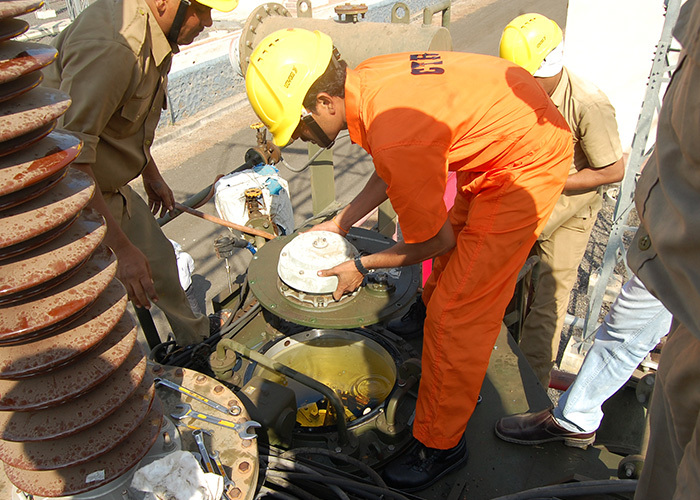
Types of OLTC Maintenance Strategies
A good maintenance programme uses a mix of approaches rather than just one.
Preventive Maintenance
Preventive maintenance is planned work done at set intervals, based on the number of tap operations, operating years or both. It includes routine condition checks, oil sampling, contact inspection and drive mechanism checks.
Breakdown Maintenance
Breakdown maintenance is the emergency repair carried out after a fault. It costs more and causes longer outages, so the goal of the other strategies is to keep it to a minimum. Having a service partner who can reach your site quickly makes a real difference here.
Condition-Based and Predictive Maintenance
In this case, maintenance is based on the actual condition of the component.The dissolved gas analysis (DGA) of the OLTC oil, motor current signatures, torque readings and dynamic resistance measurement are used to decide if an overhaul is needed now or can wait.
Comprehensive vs Non-Comprehensive Servicing
Service providers such as CTR offer two levels of OLTC servicing:
Comprehensive servicing covers full diagnostic checks, contact inspection and oil replacement. Also cover resistor and mechanism overhaul.
Non-comprehensive (preventive) servicing covers routine condition checks and minor maintenance. This service suited units with lighter duty and a good history.
The right choice depends on operating history, tap operation count and site requirements.
OLTC Inspection: Step-by-Step Checklist
A structured inspection allows you to identify problems early.Always isolate, de-energize and follow your plant’s safety procedures before opening any tap changer.
Routine Visual and Operational Checks
Check the tap position indicator and the operation counter. Then record both these operation data. Inspect the drive mechanism housing for moisture, rust and condensation. Also check the heater and the breather. Since a saturated breather lets moisture into the oil. Look for oil leaks at gaskets, flanges, the drive shaft seal and the pipework.Also check the oil level in the OLTC conservator. Finally, operate the OLTC locally and remotely. This confirms that you have the correct tap sequence and position indication.
Internal Inspection
Inspect the fixed and moving contacts of the selector switch. Inspect the diverter switch contacts for pitting, burning, erosion and carbon build-up. Measure wear on contacts against manufacturer limits. Then replace those that are nearing limits.
Check the transition resistors for cracks, discoloration and correct resistance. Also Check epoxy and insulating components such as spacers, moving arms and shafts for tracking or damage. Check all connections for tightness, and the condition of the copper braids and collector rings. Clean the diverter compartment, removing sludge and carbon particles.
Check Drive Mechanism
Check the motor, gearbox, limit switches and mechanical stops. Also check interlocks, emergency stop and step by step operation. Lubricate moving parts only as recommended by the manufacturer. Ensure that the drive shaft and the Geneva wheel run freely.
Check Protective Device
Check oil surge relay (OSR) and pressure relief switch for proper tripping.Check the Buchholz relay and the alarm/trip circuits too. Then check the trip wiring to the transformer breaker.
Common OLTC Failures and Their Causes
Knowing the typical failure modes helps you target inspections.
Contact Wear and Coking
Repeated arcing erodes contacts and builds carbon deposits. This raises contact resistance and heat and, if ignored, can lead to overheating or loss of contact.
Diverter Switch Faults
Worn components, broken springs or slow switching can leave the diverter stuck in an intermediate position, which is a serious condition.
Oil Contamination
Moisture and carbon particles lower dielectric strength and may cause flashover inside the compartment.
Drive Mechanism Problems
Worn gears, failed limit switches, motor issues and loose couplings can cause incomplete tap changes or out-of-step operation.
Transition Resistor Damage
Overheated or cracked resistors may change the switching behaviour and lead to diverter damage.
Failure of Protective Devices
An OSR, pressure relief switch or Buchholz relay that does not operate in time allows a minor fault to become a major one.
When To Hire Expert OLTC Support
In-house teams can perform routine checks. In several situations that require specialist support to fix the issue.These are: internal overhaul of a diverter switch; abnormal DGA or DRM results; breakdown or suspected internal fault; retrofit, replacement or modification work.Specialist help is also worth considering when genuine spares are hard to find, or when you need trained engineers and calibrated diagnostic equipment.
How CTR Supports OLTC Maintenance
CTR’s spares and servicing division focuses on asset management through life enhancement and reliable service. Trained engineers provide prompt on-site service using genuine spares. The service scope covers servicing, inspection, site visits and surveys, as well as overhauling, breakdown maintenance and preventive maintenance. It also includes troubleshooting, leakage repair and fitment, replacement, retrofit, modification and refurbishment, and preventive and yearly maintenance contracts. For power transformers, we offer life extension, leakage removal, drying and filtration.
CTR also provides worldwide spares and servicing for onload and off-circuit tap changers, in-tank onload tap changers, drive mechanisms, tapchanger filtering devices, radiators, transformer conservator isolation valves and oil surge relays. For faster regional response, service offices are located in Pune, Nashik, Aurangabad, Delhi, Kolkata, Hyderabad, Chennai, Vadodara, Bengaluru, Jaipur and Mumbai.
Training Your Maintenance Team
Well-trained staff catch problems sooner. CTR offers preventive maintenance training covering tapchanger condition diagnosis, performance testing, operation and maintenance practices. You can also explore the Knowledge Enhancement Institute for further learning.
Conclusion
Effective OLTC maintenance is all about regular inspections, timely testing, maintaining good oil quality and keeping essential spare parts ready.Done well, it cuts unplanned outages. Also extends transformer life and lowers lifetime cost.
If you need help with OLTC inspection, testing, overhaul, retrofit or spares, talk to CTR’s service engineers. Visit the Spares and Servicing page or call 9028053023 to discuss your installation.
REACH US
THANK YOU!
We've received your message and
we'll get back to you soon!